
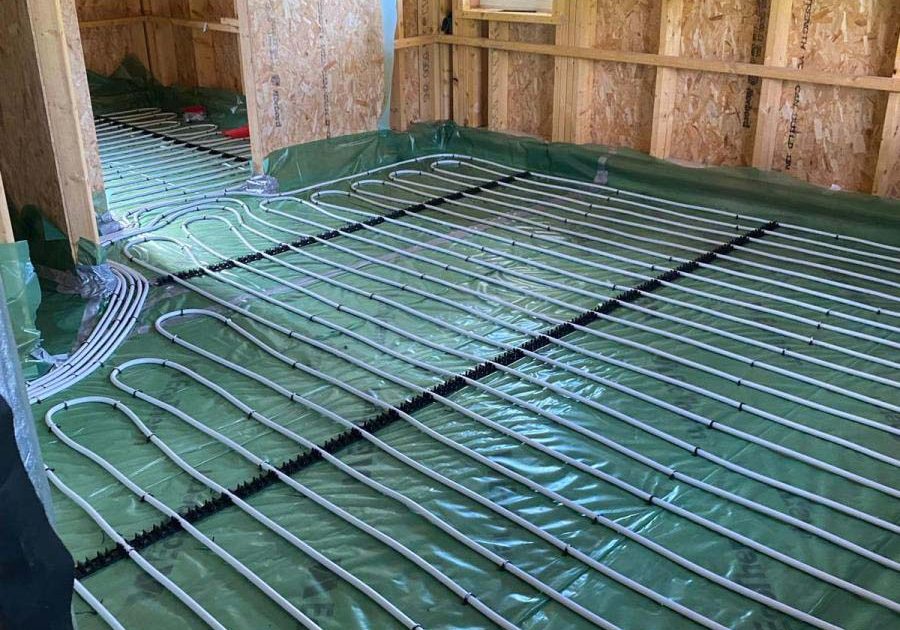
Underfloor heating is inexpensive to install into a floor that is being built anyway and expensive to install into one that is not. That single distinction explains most of the price variation between quotes.
The second factor is the heat source, because underfloor runs at low flow temperatures and pairs naturally with a heat pump but needs blending on a boiler system.
New build and extension: the cheap case
Where a floor is being laid from scratch, pipe is clipped to insulation and screeded over as part of works already happening. The incremental cost is the pipe, manifold, insulation upgrade and controls, and the labour overlaps with the floor build.
This is the scenario where underfloor is often cheaper over the life of the system than radiators, because it allows lower flow temperatures and frees wall space entirely.
Retrofit into an existing room: the expensive case
- Floor height: low-profile systems exist, but doors, thresholds and skirtings usually need adjusting.
- Substrate: suspended timber floors need a different approach from solid concrete.
- Insulation: retrofitting without insulating beneath simply heats the ground.
- Disruption: the room is out of use, and floor coverings are replaced.
The heat source question
Underfloor wants flow temperatures well below what a boiler naturally produces, so a boiler-fed system needs a blending manifold and its own controls. A heat pump produces those temperatures natively, which is why the two are so often specified together.
Mixing underfloor downstairs with radiators upstairs is entirely normal — it just needs proper zoning so the two circuits are controlled independently.
Where it makes most sense
- Bathrooms and wet rooms, where warm floors and no radiator both matter.
- Kitchen and living extensions with large glazed areas.
- Whole ground floors in renovation projects where the floor is coming up anyway.
- Any property moving to a heat pump where emitter output needs increasing.
Frequently asked questions
- Is underfloor heating slower to respond?
- A screeded floor has thermal mass, so it warms and cools gradually. With weather compensation and sensible scheduling that is an advantage, not a drawback — but it does mean it is not suited to short bursts of heat on demand.
- Can I put it under any floor covering?
- Tile and stone are ideal. Engineered wood and suitable vinyl work with the right specification and temperature limits. Thick carpet and heavy underlay reduce output significantly.
- What happens if a pipe leaks under the screed?
- Continuous pipe runs with joints only at the manifold are the standard for exactly this reason — there should be no buried joints. Pressure testing before screeding is part of a correct installation.
- Can I heat just the bathroom?
- Yes, and it is one of the most popular single-room applications, often installed as part of a wet room or bathroom refit.
Price underfloor heating against your actual floor build-up
Tell us whether the floor is being replaced, and whether the heat source is a boiler or a heat pump.