
The most common disappointment with heat pumps is not the appliance. It is emitters. A heat pump delivers water at perhaps 45 degrees where a boiler delivered 70, and a radiator sized for 70 degree water simply cannot push the same heat into the room at 45.
The fix is bigger emitters, and it is worth understanding because it is the single decision that determines whether your heat pump runs cheaply for twenty years or fights the house every winter.
The physics in one paragraph
A radiator's output depends on the difference between the water temperature inside it and the air temperature in the room. Drop the water from 70 degrees to 45 and that difference roughly halves, so the radiator's output falls dramatically — commonly to somewhere around 40 to 50 per cent of its boiler-era figure.
To restore the room's heat input you need more radiator surface: a taller or longer panel, a double panel instead of a single, or more convector fins. That is all upsizing means. It is not a sign the heat pump is underpowered.
How output falls with flow temperature
| Flow temperature | Approximate output | Typical use |
|---|---|---|
| 70°C | 100% (rated) | Traditional boiler design |
| 60°C | ~75% | Boiler running efficiently, condensing |
| 55°C | ~62% | High-temperature heat pump or hybrid |
| 50°C | ~50% | Retrofit heat pump, upsized emitters |
| 45°C | ~40% | Well-designed heat pump retrofit |
| 40°C | ~30% | Insulated homes, underfloor or large emitters |
| 35°C | ~22% | Underfloor heating, best efficiency |
Why running the heat pump hotter is a false economy
You could avoid upsizing radiators by asking the heat pump to run at 55 or 60 degrees. Many will do it. The problem is that a heat pump's efficiency falls as flow temperature rises — every extra degree costs you performance, every hour of every day, for the life of the system.
Spending once on larger radiators to enable a lower flow temperature buys a permanently lower electricity bill. Spending nothing on radiators and running hot saves money on day one and costs more every year afterwards. Over a twenty-year system life, the arithmetic is not close.
Which rooms usually need changing
- North-facing rooms and rooms with two or more external walls, common in exposed Borders properties.
- Rooms with large single-glazed or original sash windows, typical in Kelso, Melrose and the East Lothian conservation areas.
- Bedrooms with small towel-rail-sized radiators fitted when the room was rarely heated.
- Extensions with radiators sized on a rule of thumb rather than a calculation.
- Bathrooms, where the heat demand is high relative to the small emitter that fits.
What upsizing actually involves
Usually less than people fear. In many cases a single panel radiator is swapped for a double panel double convector of the same length and height, using the same pipe centres and valves. That is a quick job with no decorating disruption.
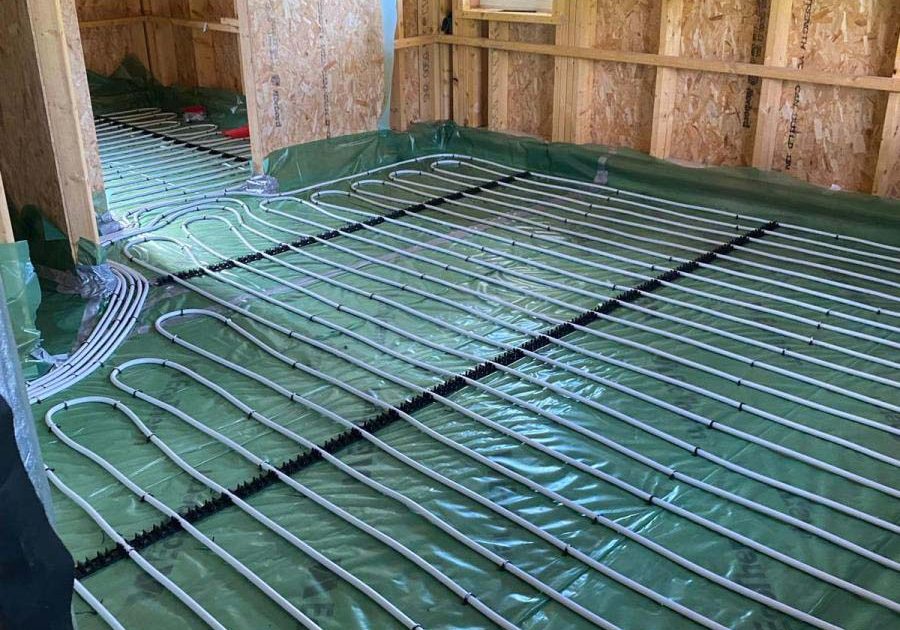
Where the wall space does not allow it, options include a taller radiator, a longer one on a different wall, a low-level fan-assisted convector, or underfloor heating in rooms being renovated anyway. A good heat loss survey identifies which rooms need what, so you are not replacing radiators that were already adequate.
| Work | Pricing approach | Notes |
|---|---|---|
| Like-for-like radiator upsize, same pipe centres | Quoted after survey | Panel swap, existing valves may be reused |
| Upsize with pipework alteration | Quoted after survey | New pipe centres or relocation |
| Designer or vertical radiator | Quoted after survey | Useful where wall space is limited |
| Fan-assisted low-level convector | Quoted after survey | High output in a small footprint |
| Underfloor heating, single room retrofit | Quoted after survey | Suits rooms already being renovated |
| Full system pipework upgrade | Quoted after survey | Only where the survey finds flow restrictions |
Pipework: the other half of the question
Lower flow temperatures mean more water has to circulate to deliver the same heat. On systems with 8 mm or 10 mm microbore pipework, that can be a genuine constraint, and some or all of the distribution may need upgrading to 15 mm or 22 mm.
This is checked at survey rather than assumed. Plenty of properties with conventional 15 mm and 22 mm pipework need no distribution changes at all, and the emitter work is the whole job.
Balancing and commissioning
Once emitters are right, the system has to be balanced so each radiator receives its designed flow. This matters far more on a heat pump than on a boiler, because there is no excess temperature available to paper over uneven distribution.
Proper commissioning also sets the weather compensation curve so the flow temperature rises only as the outside temperature falls. In a Borders winter that means the system spends most of the season running at its most efficient, and only pushes to higher temperatures on the genuinely cold days.
Frequently asked questions
- Do I have to replace every radiator?
- Almost never. A room-by-room heat loss calculation typically shows a proportion of radiators are already large enough, particularly in rooms that were over-radiated originally. We only change what the calculation requires.
- Can I keep my radiators and just run the heat pump hotter?
- Physically yes, financially no. Every degree of extra flow temperature reduces efficiency permanently. Upsizing emitters is a one-off cost that lowers running cost for the system's whole life.
- Are heat pump radiators different products?
- No, they are standard radiators — just larger, or double panel rather than single. There is no special heat pump radiator you have to buy.
- Is underfloor heating better with a heat pump?
- It is the ideal match because it works at very low flow temperatures. It is rarely worth retrofitting throughout an existing house, but it is an excellent choice in extensions and rooms being renovated.
Find out which radiators actually need changing
Our heat pump surveys include a room-by-room heat loss calculation, so you know exactly which emitters need work and which do not.