
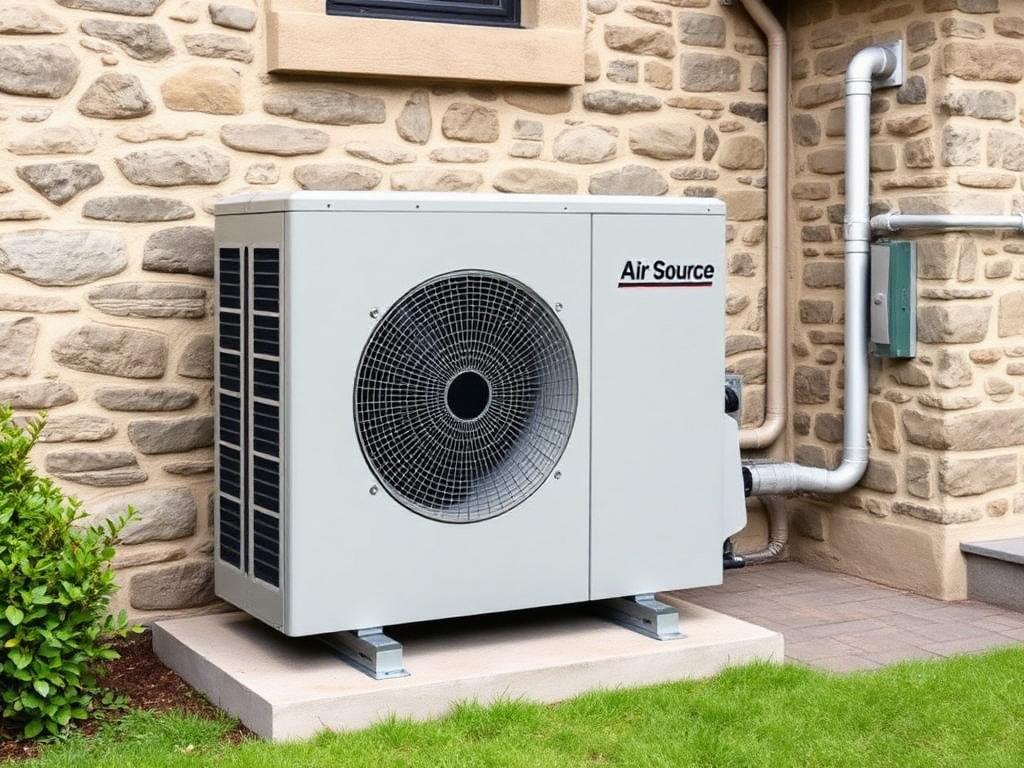
An air source heat pump does not burn anything. It moves heat that already exists in the outside air into your heating system using a refrigeration cycle, in the same way a fridge moves heat out of its compartment. Because it moves heat rather than creating it, a well designed system delivers roughly three to four units of heat for every unit of electricity it uses.
That single fact explains almost every design decision that follows: the low flow temperature, the emphasis on radiator sizing, the insulation questions and the reason a heat pump quote starts with a heat loss survey rather than a price list.
The outdoor unit: what it is and where it goes
The outdoor unit contains the fan, the evaporator coil and the compressor. It sits on a base or wall brackets outside, needs clear air flow front and back, and must not be boxed into a tight recess where it recirculates its own cold exhaust air. In practice we look for a position with good airflow, sensible pipe runs to the plant location, a defrost water path that will not create an icy path in winter, and enough distance from bedroom windows and neighbouring boundaries.
Modern units run at roughly 40 to 50 decibels measured at close range, which is comparable to a fridge in a quiet kitchen. Siting matters more than the headline figure: a unit facing a hard wall a metre away will always be more noticeable than the same unit with open space in front of it.
- Clear airflow in front of the fan and behind the coil.
- Level, stable base or brackets rated for the unit weight.
- Condensate and defrost water routed away from paths and doorways.
- Sensible pipe run length to the cylinder and controls.
- Consideration of boundaries and windows, including permitted development limits.
What changes inside the house
Inside, a heat pump normally means a hot water cylinder with a large coil, a small amount of plant space, new controls and, in many properties, some radiator upsizing. Heat pumps run at lower flow temperatures than gas or oil boilers, so emitters need more surface area to deliver the same heat. Underfloor heating suits them particularly well, which is why we often pair the two.
None of this is guesswork. The MCS design process calculates room by room heat loss, then sizes the unit and the emitters to that calculation. If a quote arrives without a heat loss survey behind it, treat the number with caution.
Cold weather performance in the Borders and Lothians
Modern units operate down to around minus 15 degrees, which comfortably covers Scottish winter conditions. Efficiency falls as it gets colder, which is exactly why the design is sized against your local design temperature rather than an average. Systems designed properly for Scottish conditions do not need to fall back on immersion heating on ordinary cold days.
Periodic defrost cycles are normal in damp cold weather. The unit briefly reverses to clear frost from the coil, then resumes. It is designed behaviour rather than a fault.
Why MCS certification matters to you
We are MCS certified and members of the RECC consumer code. That is not a badge for its own sake: MCS certification is what makes a Home Energy Scotland Grant and Loan application possible, and it commits the installation to a defined design and commissioning standard. It also means the paperwork you will need later, when selling the house or claiming under the scheme, exists and is correct.
Frequently asked questions
- How big is the outdoor unit?
- For a typical family home, expect something broadly the size of a large kitchen appliance on its side, mounted on a base outside with clear space around it. Exact dimensions depend on the kilowatt output your heat loss survey calls for.
- Do I need planning permission for the outdoor unit?
- Many domestic installations fall under permitted development in Scotland, subject to siting, size and boundary conditions, and listed buildings or conservation areas are treated differently. We assess this at survey stage and tell you plainly if consent is needed.
- Will a heat pump work with my existing radiators?
- Sometimes, partly. Because flow temperatures are lower, some radiators usually need upsizing. The heat loss survey identifies which ones, and any upgrades are included in your quote rather than appearing later as an extra.
- Is the outdoor unit noisy for neighbours?
- Modern units are quiet, typically around 40 to 50 decibels close to the unit, and siting has more effect than the specification. We position units to keep noise away from bedroom windows and boundaries.
Find out whether a heat pump suits your home
We start with a heat loss survey, not a sales pitch. If your property is not a good candidate yet, we will tell you what would need to change first.