
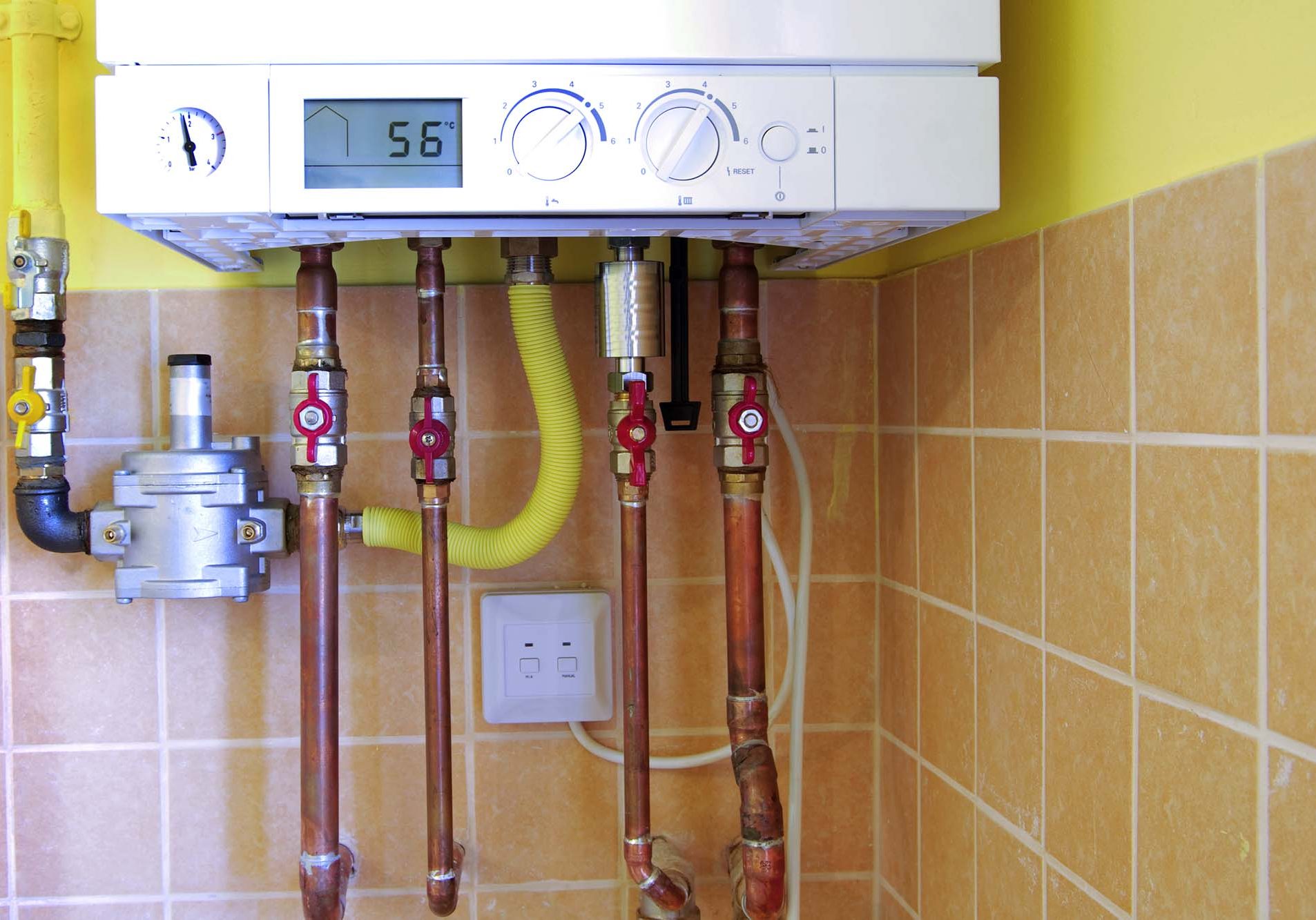
A boiler gauge creeping past 2.5 or 3 bar isn't something to ignore, but it's rarely an emergency either. Most systems will simply lock out or start weeping from the pressure relief valve (PRV) before anything serious happens. The trick is knowing whether you've caused it (an overfilled system) or whether a component has failed underneath you.
September is when this shows up a lot. Heating gets switched back on after months of standing idle, radiators that were bled or drained over summer get refilled, and a filling loop left cracked open overnight slowly pushes pressure well past where it should sit. We'll walk through what the numbers mean and what you can safely do yourself.
What counts as too high
Most domestic combi and system boilers are designed to run at 1.0 to 1.5 bar when the system is cold. As water heats up it expands, so it's normal for the needle to climb to somewhere around 2.0 to 2.5 bar once the heating has been running for a while. Anything sitting above 3 bar cold, or a gauge that's pinned into the red zone permanently, needs attention.
The pressure relief valve on most boilers is set to lift at 3 bar. If you're seeing water dripping from a pipe outside the property (usually low down on an outside wall), that's the PRV doing its job and dumping pressure because it's got too high internally.
Reading the gauge: what the numbers mean
| Reading (cold) | What it means | Action |
|---|---|---|
| Below 1.0 bar | System is under-pressurised | Top up via filling loop to 1.0 to 1.5 bar |
| 1.0 to 1.5 bar | Normal, healthy range | No action needed |
| 1.5 to 2.0 bar | Slightly high, keep an eye on it | Bleed a small amount off, monitor over a few days |
| 2.0 to 3.0 bar | Too high, likely overfilled or expansion vessel issue | Bleed down to 1.2 bar, check for recurrence |
| Above 3.0 bar / PRV discharging outside | Dangerous overpressure | Bleed down immediately, call an engineer if it recurs |
Common causes
- The system was simply overfilled during a top-up, most often when the filling loop tap was left open too long
- A filling loop valve that isn't fully closed, letting mains pressure creep in slowly overnight
- A failed expansion vessel, where the rubber diaphragm has perished and the vessel can no longer absorb the water's expansion as it heats
- A sticking pressure relief valve that isn't lifting when it should, allowing pressure to build unchecked
- On combi boilers, a cracked plate heat exchanger can let mains cold water pressure cross into the heating circuit, which shows up as pressure that keeps climbing on its own with no top-up
How to bring the pressure down yourself
If the boiler is cold and reading above 2.5 bar, the simplest fix is to bleed a radiator. Use a radiator key on one of the bleed valves, ideally on an upstairs radiator, and open it slowly with a cloth and small container ready to catch drips. Close it again the moment you see a small dribble of water rather than just air, and check the gauge, it should drop by a small amount each time.
Some systems have a dedicated drain point near the boiler or on the return pipework, which does the same job without opening a radiator. Only bleed a little at a time and recheck the gauge between attempts, it's easy to overcorrect and end up under-pressurised instead.
If pressure climbs straight back up within a day or two of bleeding it down, that points to a filling loop not being sealed properly, or a failed expansion vessel that needs recharging with air or replacing outright. Both are straightforward jobs for an engineer but not something to keep bleeding down week after week.
When to stop DIY-ing it
Bleeding a radiator once or twice to correct a slightly high reading is completely normal maintenance. But if the pressure keeps returning to 3 bar within days, or the PRV is regularly discharging outside, that's a sign something has actually failed rather than just being overfilled. Left unchecked, a failing expansion vessel or sticking PRV can mean nuisance lockouts and, eventually, damage to seals and pump components from sustained overpressure.
If it keeps happening, get an engineer to look rather than repeatedly bleeding the system, it's usually a five-minute diagnostic to find the actual cause.
Frequently asked questions
- Is it safe to run a boiler at 2.5 bar?
- Briefly while hot, yes, that's within the normal operating range for most systems. If it's sitting at 2.5 bar cold, that's too high and should be bled down towards 1.2 bar.
- Why does my boiler pressure keep going up on its own?
- This usually means a filling loop valve isn't fully closed, an expansion vessel has failed, or on a combi boiler the plate heat exchanger has developed a crossover fault letting mains water into the heating circuit.
- Can I just keep bleeding a radiator whenever pressure gets high?
- Occasionally, yes, but if you're doing it more than once every few weeks the underlying cause needs fixing rather than managing.
- Why is water dripping from a pipe outside my house?
- That's almost always the pressure relief valve discharging because the system pressure has exceeded around 3 bar. It needs investigating rather than left running.
Pressure won't stay put?
If bleeding it down doesn't hold, our Gas Safe engineers can find and fix the actual cause.