
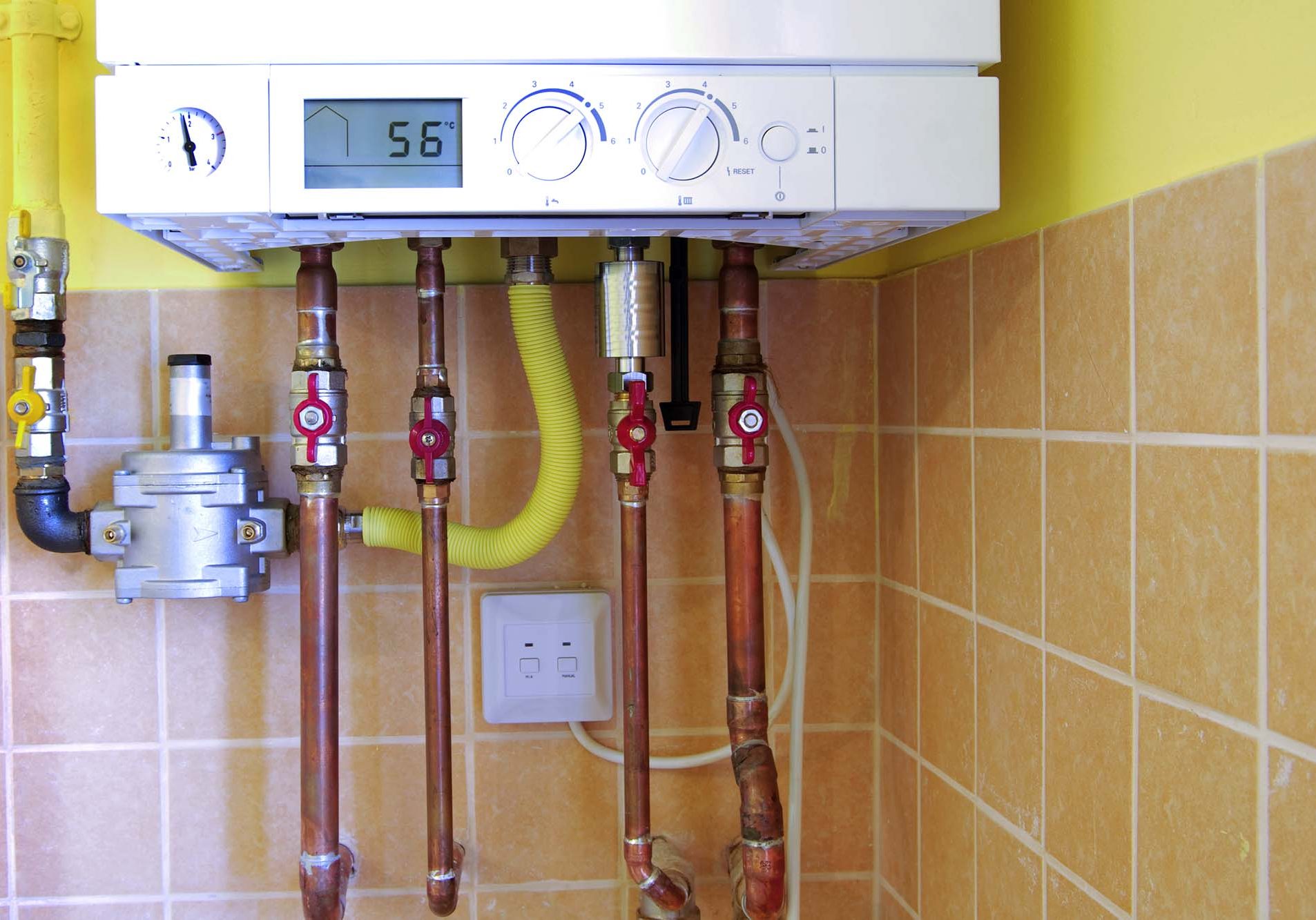
A sealed heating system should hold its pressure for months. If the gauge is sitting under 1 bar again a week after you topped it up, water is leaving the system somewhere, or the system cannot absorb the expansion when it heats up. Those are two different faults with two different repairs, and topping up repeatedly makes both worse by pulling fresh oxygenated water into the radiators.
The diagnostic order below is the one we work through on a call-out. It rules out the cheap causes before anyone starts lifting floors.
Step one: rule out the filling loop and the PRV
The most common cause is the simplest. A filling loop that has not been closed fully, or a worn filling valve, lets mains water trickle in — which shows as pressure rising when cold, then the pressure relief valve (PRV) dumping the excess outside. If there is a small copper pipe on an outside wall near the boiler that drips or shows a limescale trail, the PRV has been passing.
A passing PRV is often a symptom rather than the fault: it opens because pressure went too high, and once its seat is scaled it will not reseal. Replacing the valve without finding out why pressure spiked simply repeats the failure.
Step two: test the expansion vessel
The expansion vessel gives heated water somewhere to expand into. When its internal diaphragm fails or the air charge leaks away, pressure swings hard — low when cold, near the red when hot — and the PRV releases water each heating cycle. That is why pressure keeps falling.
- Symptom pattern: big swing between cold and hot pressure readings.
- Test: drain the system side, check the Schrader charge against the boiler's stated pre-charge.
- Fix: recharge if the diaphragm is intact, replace the vessel if it is not.
- On older systems an external vessel is often the tidier and cheaper answer.
Step three: find the leak — without lifting the whole floor
If the loop is closed and the vessel is sound, the system is leaking. Radiator valve glands, towel-rail tails and pump head seals weep slowly enough to evaporate without leaving a visible puddle. Buried pipework under a screed or beneath floorboards is harder, which is where thermal imaging and tracer methods earn their keep rather than speculative lifting.
Our leak detection work is deliberately non-destructive first: we locate before we open anything up.
When pressure loss means the system needs more than a repair
Repeated top-ups pull in fresh water, and fresh water carries oxygen. Oxygen plus steel radiators makes magnetite sludge, which then blocks the heat exchanger and the pump. If a system has been topped up weekly for a year, a repair alone rarely restores performance — a power flush, a magnetic filter and correct inhibitor dosing usually need to follow the leak repair.
Frequently asked questions
- What pressure should my boiler sit at?
- Most domestic sealed systems run around 1 to 1.5 bar cold, rising to roughly 1.8 to 2 bar when hot. Check the boiler manual, because a few manufacturers specify differently. What matters more than the exact number is stability: a healthy system barely moves month to month.
- Is it safe to keep topping the boiler up?
- Occasionally, yes. Weekly, no — you are masking a fault and introducing oxygenated water that corrodes radiators from the inside. If you are topping up more than two or three times a year, get the cause diagnosed.
- Can I fix a passing pressure relief valve myself?
- No. It is a gas appliance safety component and, on a gas boiler, work on it falls under Gas Safe scope. It also usually indicates an expansion vessel fault that needs testing properly.
- How long does diagnosis usually take?
- Filling loop and vessel checks are typically done inside an hour. A concealed leak takes longer because the point is to find it without unnecessary damage — we would rather spend the extra hour locating than open a floor on a guess.
Stop topping the boiler up every week
Tell us the cold and hot pressure readings and roughly how often you re-pressurise — that alone narrows the cause before we arrive.