
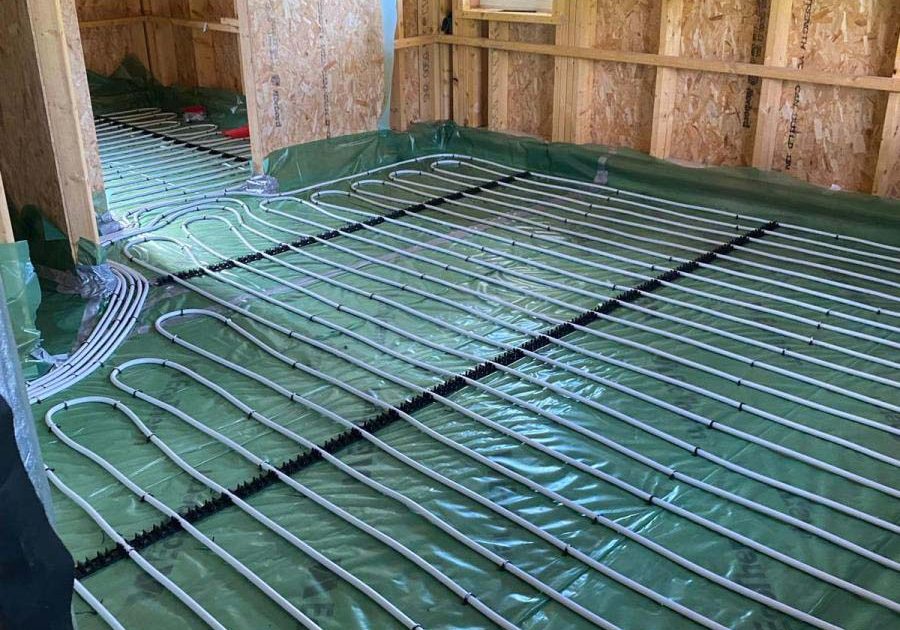
The fear with underfloor heating is always the same: that a leak means lifting an entire floor. In practice it very rarely does. Most losses are found at the manifold, at the connections, or in one identifiable loop, and modern tracing methods narrow the location before anything is lifted at all.
This guide covers the signs that point at a leak rather than at ordinary system behaviour, the immediate steps that limit damage, and how tracing actually works. It also covers the honest possibility that your pressure loss is nothing to do with the underfloor circuit at all.
The signs that suggest a leak
Falling system pressure is the headline symptom. If you are topping the system up more than once or twice a year, water is leaving somewhere. With underfloor heating, the additional clues are physical: a warm patch on a floor that should be evenly heated, a persistently damp or cold spot, or a musty smell in one part of a room.
Timber and engineered floors show it differently. Cupping, lifting edges or a board that has started to move seasonally when it never used to can all indicate moisture below. On tiled floors, look at the grout lines for staining that reappears after cleaning.
- Repeated pressure top ups with no visible leak elsewhere.
- A warm spot that stays warm when the system is off.
- Damp, cold or discoloured patches in the floor finish.
- Timber flooring cupping or lifting in one area.
- The boiler locking out on low pressure more often over time.
What to do straight away
Note the pressure reading cold, then note it again the next day and the day after, without topping up in between unless the boiler locks out. A written record of how fast pressure falls is genuinely useful, because a fast loss and a slow weep are investigated differently.
If you can isolate the underfloor circuit at the manifold, do so and watch whether the pressure loss stops. That single test can tell you within a day whether the underfloor circuit is involved at all, or whether you are chasing a leak on the radiator side or an expansion vessel fault instead.
How leaks are traced
Tracing starts with the manifold, because that is where the joints are and where most losses turn out to be. Actuators, isolation valves, flow meters and compression joints are all accessible, and a slow weep there mimics a screed leak exactly while being straightforward to fix.
If the manifold is dry, individual loops are isolated one at a time to identify which circuit is losing water. Thermal imaging then follows the warm pipe runs, and acoustic equipment listens for the sound of escaping water under the screed. Between them, the location can usually be narrowed to a small area rather than a room.
| Location | How common | Typical repair |
|---|---|---|
| Manifold joints, valves and actuators | Very common | Accessible repair, no floor lifted |
| Connections where pipe enters the screed | Common | Small localised access |
| A single loop within the screed | Less common | Targeted opening after tracing |
| Not the underfloor circuit at all | Worth ruling out | Radiator side leak or expansion vessel |
Why guessing is the expensive option
Opening screed on a hunch is the one approach that reliably costs more than it should. Every unnecessary opening means reinstating screed, waiting for it to cure and relaying a floor finish, and none of that gets you closer to the leak if the loss was at a manifold joint all along.
Proper tracing before any opening is why leak detection exists as a separate discipline. We use it precisely so the repair is targeted, and so that the reinstatement is a patch rather than a room.
Prevention worth having
- Keep the correct level of corrosion inhibitor in the system.
- Have the manifold checked as part of an annual service.
- Fit a magnetic filter to keep debris out of narrow underfloor pipework.
- Record your normal cold pressure so you notice a change early.
- Keep the original loop layout drawing if you have one, since it saves tracing time.
Frequently asked questions
- How do I know if my underfloor heating is leaking?
- The main sign is system pressure that keeps dropping with no visible leak elsewhere. Supporting signs are a warm or damp patch in the floor, cupping timber, or grout staining that returns after cleaning. A steady loss with any of those is worth investigating.
- Will the whole floor need lifting?
- Usually not. Most losses are at the manifold or its connections, which are accessible. When a leak genuinely is in the screed, thermal imaging and acoustic tracing narrow it to a small area so only a patch needs opening.
- Can I keep using the heating with a suspected leak?
- Short term, if pressure is holding well enough to run. Ongoing use while topping up repeatedly is not a good idea, because fresh water brings fresh oxygen into the system and accelerates corrosion. Isolate the circuit at the manifold if you can.
- Could falling pressure be something other than a leak?
- Yes. A failed expansion vessel causes pressure to swing high when hot and low when cold, and it is often mistaken for a leak. A leak on the radiator side, or water escaping through a pressure relief valve outside, are also common explanations worth ruling out.
- Do you trace underfloor leaks in the Borders and East Lothian?
- Yes. We offer leak detection alongside our heating work across Kelso, the Scottish Borders and East Lothian, and we trace before opening anything so the repair stays as small as possible.
Losing pressure and worried about the floor?
We trace first and open second. Get in touch with your pressure readings and we will advise honestly.