
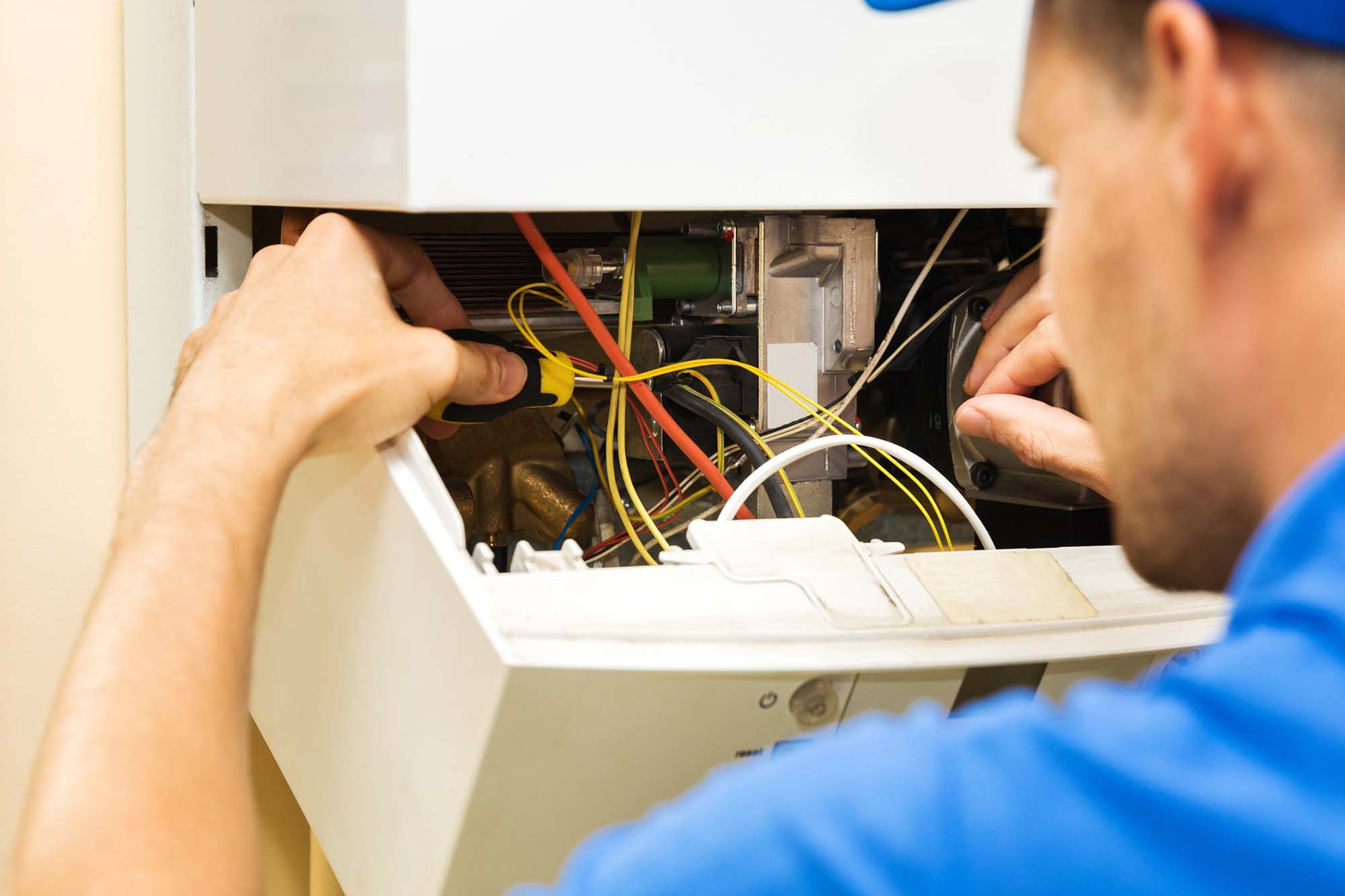
If your taps run hot but every radiator in the house is cold, the boiler itself is almost certainly firing correctly. Something is stopping that heat from reaching the heating circuit, which narrows the likely faults down to a handful of parts: the room thermostat and programmer, the three way or diverter valve, the circulating pump, or the wiring centre that ties them together.
That is genuinely good news, because it usually means a repair rather than a replacement. Work through the checks below in order first. Two or three minutes of looking will often tell you whether this is a flat battery in a wireless thermostat or a mechanical fault that needs an engineer with a multimeter.
Start with the controls, not the boiler
Heating and hot water are usually programmed separately, so a heating schedule that has slipped after a power cut will leave hot water working perfectly while the radiators never come on. Put the programmer into constant or boost, set the room thermostat several degrees above the current room temperature, and give the system ten minutes.
Wireless room thermostats run on batteries. When those batteries fade the display often still lights, but the radio signal that tells the boiler to fire the heating circuit stops getting through. Fresh batteries in both the thermostat and any wireless receiver are the cheapest test you will make all winter.
- Check the heating programme separately from the hot water programme.
- Rule out holiday or away mode on smart controls and app based systems.
- Open the thermostatic radiator valve in the room where the thermostat lives.
- If you have a smart control, confirm it is still paired after any broadband change.
The diverter valve, the classic combi cause
On a combi boiler a diverter valve decides whether the heat exchanger sends its heat to the taps or to the radiators. Hot water always takes priority. When the valve sticks in the hot water position, or its actuator motor fails, you get exactly what you are seeing: perfect hot water and dead radiators.
This is one of the most common causes of the symptom and it is not a homeowner repair, because reaching the valve means opening the boiler casing. It is, however, a routine job for an engineer, and the part is often a diaphragm, a cartridge or the motorised head rather than the whole assembly.
System boilers: the three way valve and cylinder stat
If you have a hot water cylinder rather than a combi, the equivalent part is a motorised three way valve, usually mounted on the pipework near the cylinder in an airing cupboard or plant room. When its motor fails or the internal ball seizes, the valve stays in the hot water position and never rotates to serve the heating.
You can often hear whether it is trying. Stand next to it while you call for heating: a faint buzz or click means the motor is powered and moving, silence means either no signal is arriving or the actuator has failed. Do not attempt to lever the manual lever permanently open as a workaround, because that leaves the system without control.
A seized circulating pump
The pump pushes heated water around the radiator circuit. Hot water in a cylinder system can still work through gravity or a separate circuit, so a failed pump can leave you with hot taps and cold radiators. A pump that has stood still all summer sometimes seizes and needs freeing, and a pump running with an airlock will hum without moving water.
You can feel for it. With the heating calling, place a hand on the pump body: it should be warm and gently vibrating. Stone cold and silent means no power or a failed pump. Hot and buzzing but with no flow in the pipes points at a seizure or trapped air, both of which need an engineer to resolve properly.
Sludge, and why one cold radiator is a different problem
Everything above assumes every radiator is cold. If most of your radiators heat up and only one or two stay cold, that is a balancing, air or sludge problem in that part of the circuit rather than a valve or pump fault, and it is worth reading our radiator checklist instead.
Older systems around the Borders and East Lothian that have never been flushed can build up enough magnetite to stall circulation in the coldest weather while still passing enough water to heat the cylinder. A power flush plus a magnetic filter is the long term answer there, not a repeat repair.
| What you see | Most likely cause | Homeowner or engineer |
|---|---|---|
| All radiators cold, hot water fine, combi boiler | Diverter valve stuck or actuator failed | Engineer |
| All radiators cold, cylinder heats fine | Three way valve or wiring centre fault | Engineer |
| Radiators cold and pump silent | No signal, or failed pump | Engineer |
| Radiators cold and thermostat display faint | Flat batteries or lost pairing | Homeowner |
| Only one or two radiators cold | Air, balancing or sludge | Start as homeowner |
When it needs a Gas Safe engineer
- You have checked the controls and batteries and the radiators are still cold across the whole house.
- The boiler display shows a fault or lockout code alongside the symptom.
- You can hear the pump or valve buzzing but nothing changes at the radiators.
- The boiler fires briefly for heating then stops, which can indicate overheating from no circulation.
- You smell gas at any point, in which case stop, ventilate and call 0800 111 999.
Frequently asked questions
- Why does my hot water work but the heating does not?
- Because hot water and heating use different paths through the same boiler. Hot water takes priority, so a stuck diverter or three way valve, a failed pump, or a heating programme that is not calling for heat will all leave taps hot and radiators cold while the boiler itself works normally.
- Is a stuck diverter valve expensive to fix?
- It varies with the boiler make and whether the cartridge, the diaphragm or the whole motorised head needs replacing. It is normally a parts and labour repair rather than a reason to replace a boiler, and an engineer can tell you which part is at fault on the first visit.
- Can I fix this myself?
- You can safely check programmes, thermostat batteries, radiator valves and system pressure. Anything that involves removing the boiler casing, testing electrics inside the appliance or replacing a valve is work for a Gas Safe registered engineer.
- Could low pressure cause hot water without heating?
- Low pressure usually stops both, because most boilers lock out below roughly 0.5 bar. If pressure is normal and only the heating is missing, look at the controls, the diverter or three way valve, and the pump instead.
- How quickly can you look at it?
- We cover Kelso, the Scottish Borders and East Lothian, and losing heating counts as urgent in winter. Tell us the boiler make, whether you have a cylinder, and any code on the display when you get in touch so we can bring the likely parts.
Radiators cold while the taps run hot?
Our Gas Safe registered engineers diagnose diverter valves, pumps and controls across Kelso, the Borders and East Lothian.