
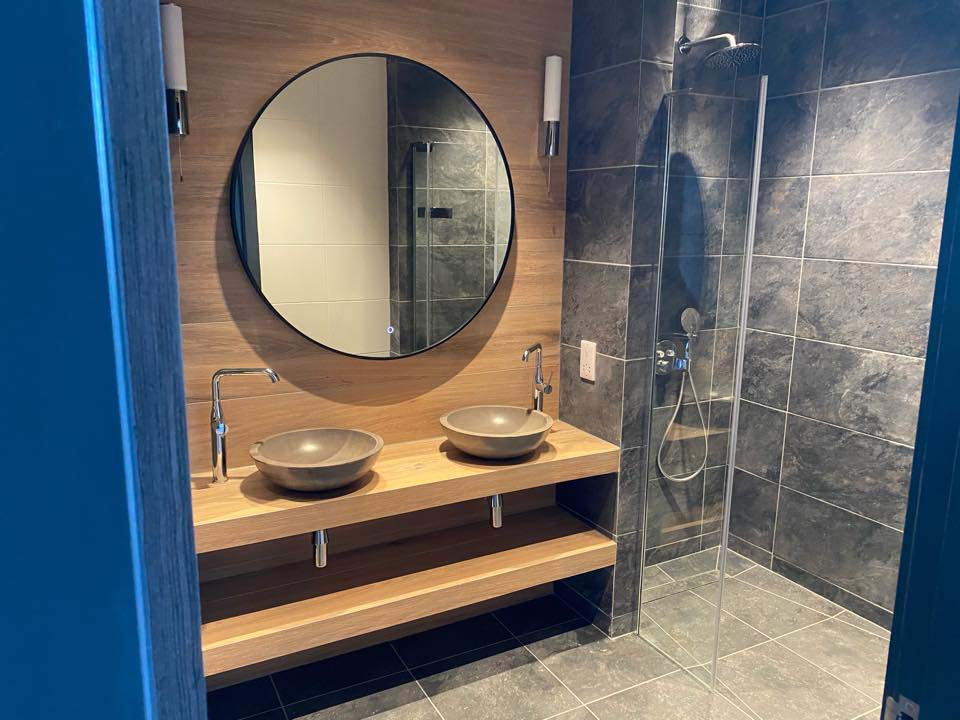
Mould in a bathroom is not a cleaning failure. It is moisture sitting on cold surfaces for long enough to grow, which means the room is producing more water vapour than it is removing. Bleach treats the symptom; the fan, the duct and the surface temperatures are the cause.
In a Scottish climate this is a year-round issue rather than a winter one, because outside air is often damp even when it is mild. This guide explains what a bathroom extract system needs to do, and the specific failures we find most often.
Why the fan you have probably is not working
- It is a basic axial fan pushing air down four metres of flexible ducting — axial fans have almost no ability to overcome duct resistance.
- The flexible duct sags into a low point where condensate collects, throttling the airflow further.
- It vents into the loft rather than outside, dumping the moisture into the roof space where it causes worse problems.
- There is no overrun timer, so it stops the moment the light goes off with the room still full of steam.
- The door has no undercut, so there is no replacement air path and the fan is trying to pull a vacuum.
- The grille and impeller have never been cleaned and are furred with dust.
What good extraction looks like
| Element | What to specify | Why |
|---|---|---|
| Fan type | Centrifugal or mixed-flow for any duct over ~1.5 m | Axial fans stall against duct resistance |
| Extract rate | At least 15 l/s for a bathroom, more for a wet room | Removes vapour faster than it is produced |
| Duct | Rigid, smooth-bore, shortest practical run | Flexible duct can halve effective airflow |
| Duct fall | Slight fall to outside, no sags | Prevents condensate pooling in the run |
| Duct insulation | Insulated through cold lofts | Stops condensation forming inside the duct |
| Overrun | 15–20 minute timer | The room is at its wettest after you leave |
| Humidity control | Humidistat in high-use bathrooms | Runs on actual moisture, not the light switch |
| Air path in | 10 mm door undercut | Fan cannot extract without make-up air |
| Termination | Through wall or roof to outside, cowled | Never into a loft or void |
Cold surfaces are the other half
Vapour condenses where surfaces are coldest. In older stone and solid-walled properties that means external wall corners, reveals, ceilings under uninsulated lofts, and behind anything pressed against an outside wall. Even a good fan cannot prevent condensation on a surface that is significantly colder than the room.
That is why a heated towel rail on a timer, a small radiator that actually gets used, or improved loft insulation above the bathroom often does as much for a mould problem as the fan does. Warm surfaces plus decent extraction is the combination that works.
Behaviour that helps more than people think
- Close the bathroom door while showering and for the overrun period, so the moisture is extracted rather than distributed round the house.
- Open the window briefly after a bath in mild weather, but do not rely on it in a Borders winter — nobody leaves a window open at minus three.
- Wipe down the screen and tiles after showering; it removes a surprising volume of water from the room.
- Dry laundry anywhere other than the bathroom. A drying rack in there overwhelms any fan.
- Keep the fan grille clean and have the impeller cleared periodically.
When mould is not condensation
Occasionally what looks like a ventilation problem is a leak: a failed shower tray seal, a weeping waste joint, a slow leak behind tiling, or water tracking from a bath overflow. The tell is mould concentrated in one area low down, or a stain that persists in dry weather when the bathroom is unused.
Persistent damp on a ground floor bathroom wall may also be rising or penetrating damp rather than anything to do with the shower. If the pattern does not match your usage, it is worth a leak detection visit before you spend money on ventilation you may not need.
Replacing sealant properly
- Remove all the old sealant mechanically — new silicone over mouldy silicone will discolour within weeks.
- Clean and dry the joint thoroughly; a fungicidal wash and time to dry, not a quick wipe.
- Fill the bath with water before sealing so the joint is at its widest, and leave it full until the silicone skins.
- Use a sanitary grade silicone with a fungicide, not a general purpose one.
- Tool the joint once, cleanly. Repeated smoothing pulls the surface and traps dirt.
What we do about it
We assess the whole picture: fan type and rate, duct route and material, termination, make-up air, surface temperatures and any sign of a leak. Then we specify extraction that will genuinely clear the room, usually with a humidistat and overrun, ducted rigidly to an outside termination.
It is a modest job with a disproportionate effect. Most households that have been scrubbing mould for years stop entirely once the extraction is right and the coldest surfaces have been dealt with.
Frequently asked questions
- How long should a bathroom fan run after a shower?
- At least fifteen minutes with the door closed. The room holds the most moisture immediately after use, which is precisely when most fans switch off with the light.
- Can I just open the window instead?
- In mild weather it helps. Through a Scottish winter nobody leaves a window open long enough, and cold incoming air makes surfaces colder. Mechanical extraction is the reliable answer.
- Is it acceptable to vent a fan into the loft?
- No. It moves the moisture into the roof space where it condenses on the cold structure and can cause timber decay. Ducts must terminate outside.
- Would a humidistat fan be better?
- In most bathrooms, yes. It responds to actual humidity rather than whether a light is on, so it runs when a bath is drawn during the day and does not run pointlessly for a brief visit.
Stop cleaning mould off the same ceiling
We assess extraction, duct routing and cold surfaces, then specify and fit ventilation that actually clears the room.