
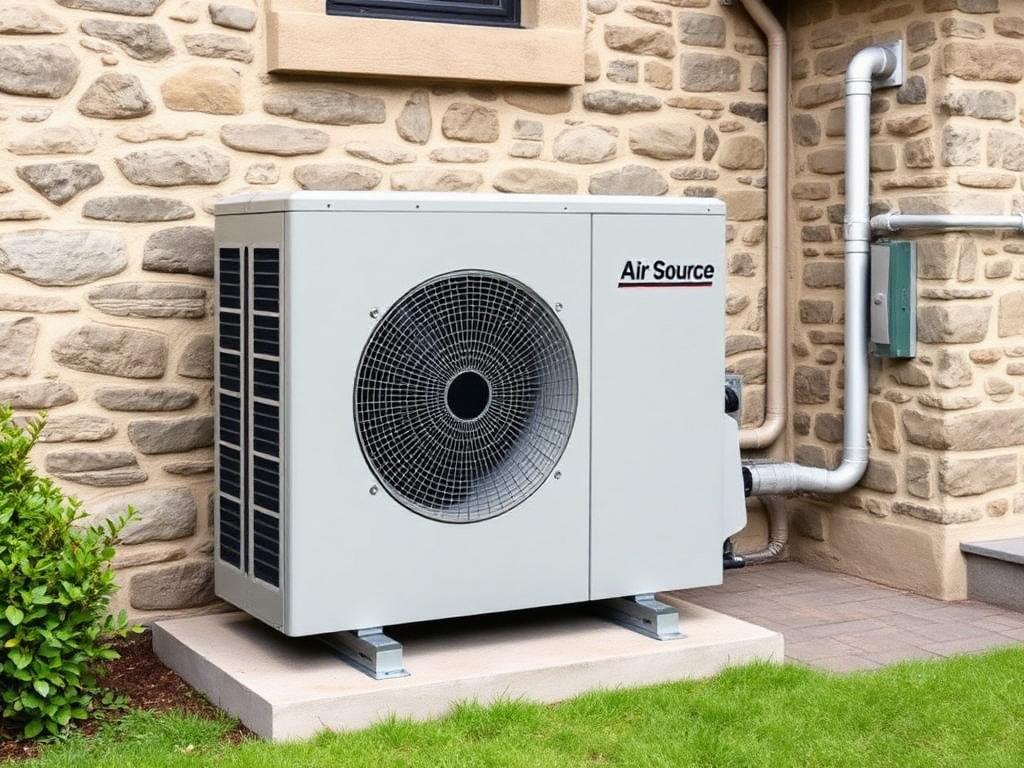
A heat pump changes a few things about how a bathroom should be specified, mostly because it produces hot water at a lower temperature than a gas boiler and works most efficiently running for longer periods rather than in short bursts. None of that rules a heat pump out for a good bathroom, but it does mean a few choices need thinking through differently.
This guide covers cylinder sizing for realistic bathroom demand, reheat times, legionella cycles, shower type, towel rail performance and why underfloor heating tends to be the natural partner for a heat pump-fed bathroom.
Lower store temperatures, bigger cylinders
A heat pump typically heats a cylinder to somewhere around 45 to 50 degrees Celsius day to day, compared with a gas boiler which might run a cylinder up to 60 degrees or more. That lower stored temperature means less usable hot water is drawn from a given cylinder volume before it needs reheating, since less cold water needs mixing in to reach a comfortable temperature at the tap.
In practice, this usually means sizing the cylinder up compared with what a gas system would need for the same household, so an unvented cylinder that might be 150 litres on a boiler system is often specified at 210 to 250 litres or more on a heat pump system serving the same bathroom demand.
Cylinder size against household demand
| Household | Bathroom demand | Indicative cylinder size |
|---|---|---|
| 1 to 2 people, one bathroom | One shower, occasional bath | 180 to 210 litres |
| 3 to 4 people, one bathroom | Morning showers back to back, occasional bath | 210 to 250 litres |
| 4 to 5 people, bathroom plus en suite | Overlapping showers, regular baths | 250 to 300 litres |
| 5+ people, multiple bathrooms | High simultaneous demand | 300 litres plus, or twin cylinders |
Reheat times and legionella cycles
A heat pump reheats a cylinder more slowly than a gas boiler, since it's designed to run for longer at a lower output rather than deliver a quick blast of heat. A full reheat on a larger cylinder can take a couple of hours rather than the twenty to thirty minutes a combi-fed cylinder might take, which is another reason sizing the cylinder correctly for actual daily demand matters more on a heat pump system.
Most heat pump cylinders still need a periodic legionella cycle, raising the water temperature higher than the day to day set point to control bacterial growth. This is usually run automatically, often using an immersion heater rather than the heat pump itself, and it's worth understanding when it's scheduled so it doesn't clash with peak household hot water use.
Mixer showers versus electric showers
A thermostatic mixer shower fed from a correctly sized unvented cylinder generally performs well on a heat pump system, with flow rates commonly in the range of 9 to 15 litres per minute depending on the valve and incoming mains pressure. This is usually the better choice where the cylinder and pipework are sized properly for it.
An electric shower, by contrast, heats mains water on demand independently of the heat pump and cylinder altogether, which can be a useful backup or a good option for an occasional-use en suite, but it typically delivers a lower flow rate and doesn't draw on the efficiency of the heat pump system at all.
Towel rails on a heat pump circuit
A heated towel rail plumbed into a heat pump's central heating circuit, rather than run off its own electric element, is sized against a lower flow temperature, commonly in the range of 35 to 45 degrees Celsius rather than the 70 degrees or more a gas boiler circuit might run. A towel rail sized for a gas boiler system and simply reused on a heat pump circuit will feel noticeably cooler and take longer to warm towels, because it was never sized against that lower flow temperature.
The fix is straightforward: size the towel rail's output in watts against the heat pump's actual flow temperature at the design stage, which usually means specifying a larger radiator-style towel rail than you might expect, or adding an electric element to boost it independently of the heating circuit when it's needed outside the heating season.
Underfloor heating: the natural partner
Underfloor heating is a strong match for a heat pump because it's designed to run at a similarly low flow temperature and heat a room gently over a longer period, which is exactly how a heat pump operates most efficiently. In a bathroom specifically, underfloor heating also helps dry a tiled floor after showering, which is a genuine practical benefit rather than just a comfort upgrade.
Pairing underfloor heating with a heat pump-fed bathroom tends to work better than relying solely on a towel rail for room heating, since the towel rail alone at a lower flow temperature may not heat the room as quickly as households are used to from a gas-fed system.
Sequencing the work
Where a heat pump and a bathroom refit are happening around the same time, it's worth finalising the heat pump's flow temperature and cylinder size before the bathroom's towel rail, shower valve and underfloor heating are specified, rather than the other way round. Getting the sequence right avoids fitting a towel rail or shower that then underperforms once the heat pump is commissioned.
Frequently asked questions
- Do I need a bigger hot water cylinder with a heat pump?
- Usually yes, indicatively. Because a heat pump stores water at a lower temperature than a gas boiler, more litres are needed to deliver the same usable hot water for showers and baths, so cylinders are typically sized up compared with an equivalent gas system.
- Will my shower be weaker with a heat pump?
- Not necessarily. A correctly sized unvented cylinder and a good thermostatic mixer valve on a heat pump system can deliver a flow rate comparable to a gas-fed system, provided the cylinder is sized against actual household demand.
- Why does my towel rail feel cold on a heat pump system?
- It's usually because the towel rail was sized against a gas boiler's higher flow temperature rather than the lower flow temperature a heat pump circuit runs at, which means it needs to be a larger unit to deliver the same warmth.
- Is underfloor heating a good idea with a heat pump?
- Yes, it's generally considered a strong match, since underfloor heating runs efficiently at the same lower flow temperatures a heat pump is designed to deliver, and in a bathroom it has the added benefit of helping the floor dry after use.
- Should I plan the heat pump or the bathroom first?
- It's best to finalise the heat pump's flow temperature and cylinder size first, so the bathroom's towel rail, shower valve and any underfloor heating can be specified correctly around it rather than needing changes later.
Planning a bathroom and a heat pump together?
Tell us about your household size and hot water demand, and we'll help you size the cylinder and bathroom fittings correctly from the outset.