
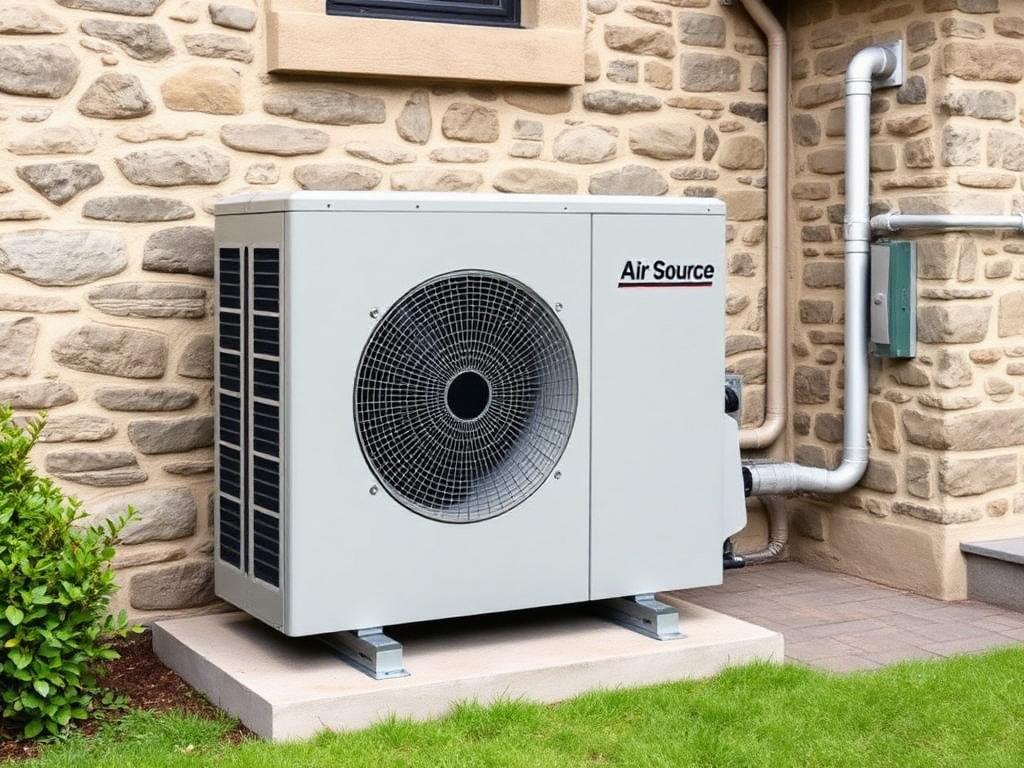
A great deal of housing across the Borders and East Lothian is solid stone: farm cottages, steadings, town houses in Kelso and Melrose, coastal properties in Dunbar and North Berwick. The standard advice — that heat pumps suit modern insulated homes — leaves those owners assuming the technology is not for them.
That is too simple. Some stone properties run heat pumps very well. Others genuinely should not fit one yet. The difference is measurable, and this guide explains what decides it.
What actually determines suitability
Not the age of the house, and not the wall construction on its own. What matters is total heat loss at design temperature, and whether the emitters can deliver that heat at a low flow temperature. A large draughty stone house with single glazing and an open chimney will fail on both counts. The same house with the loft insulated to a decent depth, draughts sealed, secondary glazing on the worst windows and generous radiators can work perfectly well.
This is why an MCS heat loss survey matters more here than anywhere. Rules of thumb wildly overestimate heat loss in some traditional buildings and underestimate it in others, because stone thickness, exposure and previous alterations vary enormously between two apparently identical cottages.
The fabric measures that move the number most
| Measure | Impact on heat loss | Pricing approach |
|---|---|---|
| Loft insulation to full depth | Large | Quoted by an insulation specialist after survey |
| Draughtproofing and chimney balloons | Large for the work involved | Depends on openings and access |
| Suspended floor insulation | Moderate to large | Depends on floor area and access |
| Secondary glazing to worst rooms | Moderate | Depends on window size and construction |
| Heavy curtains and shutters restored | Moderate | Depends on the chosen treatment |
| Internal wall insulation, selected rooms | Large but invasive | Requires a building-specific specification |
| Full external wall insulation | Largest | Rarely appropriate on stone or listed buildings |
Breathability is not a footnote
Traditional stone walls with lime mortar are designed to absorb and release moisture. Wrapping them in impermeable insulation can trap water in the fabric and cause decay, which is why blanket internal wall insulation is a poor default on these buildings.
Where wall insulation is appropriate, breathable systems using wood fibre or lime-based materials are the safe route, and they should be specified by someone who understands traditional construction. Historic Environment Scotland publishes detailed guidance on retrofitting traditional buildings, and it is worth reading before committing to any wall treatment.
What the survey usually finds in these properties
- Loft insulation present but compressed, patchy or well below current depth — an easy and large win.
- Substantial uncontrolled ventilation through open flues, gaps at skirtings and around sash boxes.
- Radiators sized for a 70 degree boiler with no headroom for lower temperatures, especially in bedrooms.
- Microbore pipework in properties updated in the 1970s and 1980s, occasionally needing distribution upgrades.
- A hot water cylinder either absent, having been removed for a combi, or too small and poorly insulated for heat pump duty.
- Rooms that are never heated and never will be, which can legitimately be excluded from the design.
Realistic outcomes
A well-executed heat pump in an improved stone property will not match the seasonal performance of the same appliance in a modern insulated house — but it does not need to in order to beat oil. Most of these properties are off the gas grid, and against oil or LPG the running cost comparison is usually favourable even at a moderate seasonal performance figure.
The comfort outcome is often the bigger change. Low temperature heating running for long periods produces a much more even warmth than an oil boiler blasting for two hours morning and evening, which is how many of these houses have been heated for decades.
When we advise against it, for now
- Where the heat loss remains so high after realistic fabric measures that the required heat pump size and emitter work cannot be justified.
- Where listing constraints prevent both emitter upgrades and any acceptable outdoor siting.
- Where the property is used intermittently — a holiday let heated in short bursts suits a fast-response system better than a low temperature one.
- Where the owner's timescale or budget cannot cover the fabric work first, in which case insulate now and revisit the heat pump later.
A sensible sequence for a traditional property
Insulate the loft properly and deal with draughts first — they are cheap, uncontroversial on traditional buildings and reduce the heat pump size you will need. Then get an MCS heat loss survey with the improved fabric assumed. Then decide between a full heat pump and a hybrid on the basis of the actual numbers.
Doing it in that order routinely reduces the required appliance size, the emitter work and the total cost, and it is the difference between a system that pleases the owner and one that disappoints.
Frequently asked questions
- Can a listed stone house have a heat pump?
- Frequently yes. The constraints are usually siting of the outdoor unit and internal alterations, both of which are negotiable with early engagement. Listed building consent may be required in addition to any planning permission.
- Do I have to insulate the walls?
- Usually not. Loft insulation, draughtproofing, floor insulation and window measures typically deliver most of the achievable reduction at a fraction of the cost and risk of wall insulation on traditional construction.
- Will a heat pump keep a stone house warm in a hard frost?
- If it has been sized to the actual heat loss at design temperature, yes. If it has been sized optimistically to keep the price down, no. This is exactly what the heat loss calculation exists to determine.
- Is a hybrid better for these houses?
- Often it is the pragmatic answer, particularly where emitter upgrades are constrained. It captures most of the running cost and carbon benefit while the boiler covers the coldest days.
Get an honest assessment of your stone property
MCS certified heat loss survey, fabric advice and a straight answer on whether a heat pump, a hybrid or fabric work first is the right next step.