
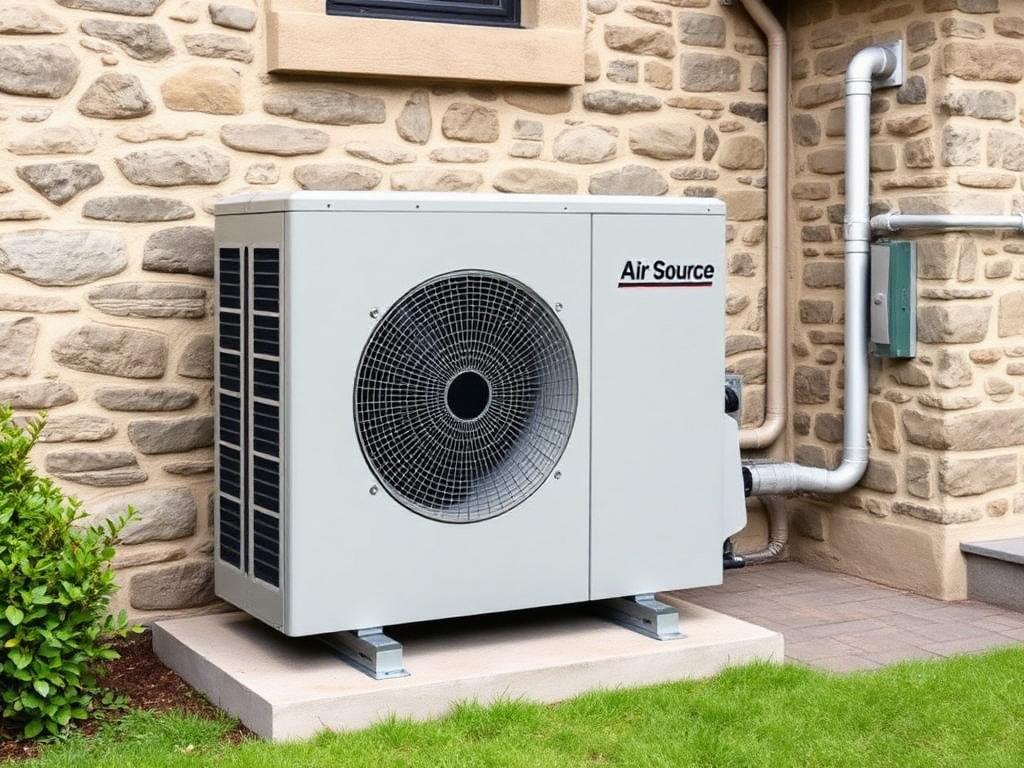
Not every house is ready for a full heat pump conversion, and pretending otherwise leads to cold rooms and disappointed customers. A hybrid system keeps a boiler alongside an air source heat pump, letting the heat pump do the bulk of the year's heating and the boiler cover the coldest days and peak hot water demand.
It is not the right answer everywhere — it costs more than one appliance and less than a full retrofit — but for certain solid-walled Borders properties it is genuinely the most sensible route.
How a hybrid actually operates
A hybrid pairs a smaller air source heat pump with a boiler, under a controller that decides which runs. On mild and moderate days — the great majority of the heating season, even here — the heat pump carries the load at a low flow temperature and good efficiency. When the outside temperature drops below the point where the heat pump can meet demand, or where the boiler becomes cheaper per unit of heat, the controller switches over.
Some hybrids run both together in cascade, with the heat pump providing base load and the boiler topping up. Hot water is usually handled by whichever the design favours — often the boiler for speed, or the heat pump into a cylinder with boiler backup.
Full heat pump, hybrid or boiler: the comparison
| Full heat pump | Hybrid | New boiler only | |
|---|---|---|---|
| Installation pricing | Quoted after survey | Quoted after survey | Quoted after survey |
| Grant funding available | Yes | Sometimes — check scheme rules | No |
| Radiator upgrades needed | Usually several | Fewer | None |
| Carbon reduction | Greatest | Substantial | Modest |
| Performance in a hard frost | Depends on design | Boiler covers it | Unaffected |
| Appliances to service | One | Two | One |
| Best for | Insulated homes, off-gas properties | Solid wall homes, staged upgrades | Short-term or budget-constrained |
Where a hybrid genuinely earns its place
- Solid stone or rubble-walled properties where the heat loss at design temperature is very high and a full heat pump would need to be large and expensive.
- Houses where several rooms cannot practically take upsized emitters, for example listed interiors or rooms with fitted furniture.
- Households that want to reduce fuel use and carbon now but cannot fund a whole-house fabric and emitter upgrade in one go.
- Properties with a relatively new, well-maintained boiler that has years of life left — a hybrid keeps that asset working.
- Homes with high peak hot water demand that would need an oversized heat pump to satisfy.
Where a hybrid is the wrong answer
- Reasonably insulated properties where a full heat pump will work well — you would be paying to keep and service a second appliance for nothing.
- Off-grid properties on oil or LPG where the boiler fuel is the expensive part; the case for keeping it is weak.
- Situations where the customer will not engage with the controls, because a badly configured hybrid defaults to the boiler and delivers none of the benefit.
- Very small properties where space for two appliances plus a cylinder is not realistically available.
The control strategy is the whole system
A hybrid lives or dies on its switchover logic. Set the changeover point too high and the boiler runs most of the winter, so you have paid for a heat pump you barely use. Set it too low and the house struggles on cold days.
Good controllers switch on a cost or carbon basis using the actual electricity and gas or oil prices, adjusting the crossover automatically. That is worth insisting on, and it is worth revisiting the settings when tariffs change — something we do at service visits rather than leaving it fixed at commissioning forever.
Running cost expectations
In a typical arrangement, the heat pump handles the large majority of heating hours even though the boiler covers the coldest ones, because most of the heating season is spent in mild rather than extreme conditions. That is what produces the saving.
Against oil the case is usually strong. Against mains gas it is narrower and depends on the electricity tariff, particularly whether a time-of-use tariff is available. We model this at survey with your actual consumption rather than presenting a generic figure.
A staged route rather than a compromise
It helps to see a hybrid as a stage rather than a permanent halfway house. Install the heat pump, upsize the emitters you can, improve insulation over the following years, and the crossover point drifts steadily downwards until the boiler is doing very little. At that point removing it is a small job.
That path suits a lot of Borders housing stock, where fabric improvement is slow, expensive and sometimes constrained by listing — but not impossible over a decade.
Frequently asked questions
- Is a hybrid eligible for Scottish funding?
- Scheme rules on hybrids have varied, so confirm the current position with Home Energy Scotland before you plan around it. Full heat pump installations are the clearest case for funding.
- Do I need two servicing visits a year?
- You need both appliances maintained, but they can usually be covered in one visit by an engineer competent on both. We service gas, oil and heat pump systems, so it is a single appointment.
- Can I add a heat pump to my existing boiler later?
- Often yes, provided the boiler is in good condition and the controls can be integrated. Planning the cylinder and pipework with that in mind now makes it much cheaper later.
- Will the boiler run most of the time?
- It should not. With a properly set changeover point, the heat pump covers the large majority of heating hours and the boiler handles cold snaps and peak hot water.
Find out whether a hybrid suits your property
We model full heat pump and hybrid options against your actual fuel use, then quote whichever genuinely serves the house better.