
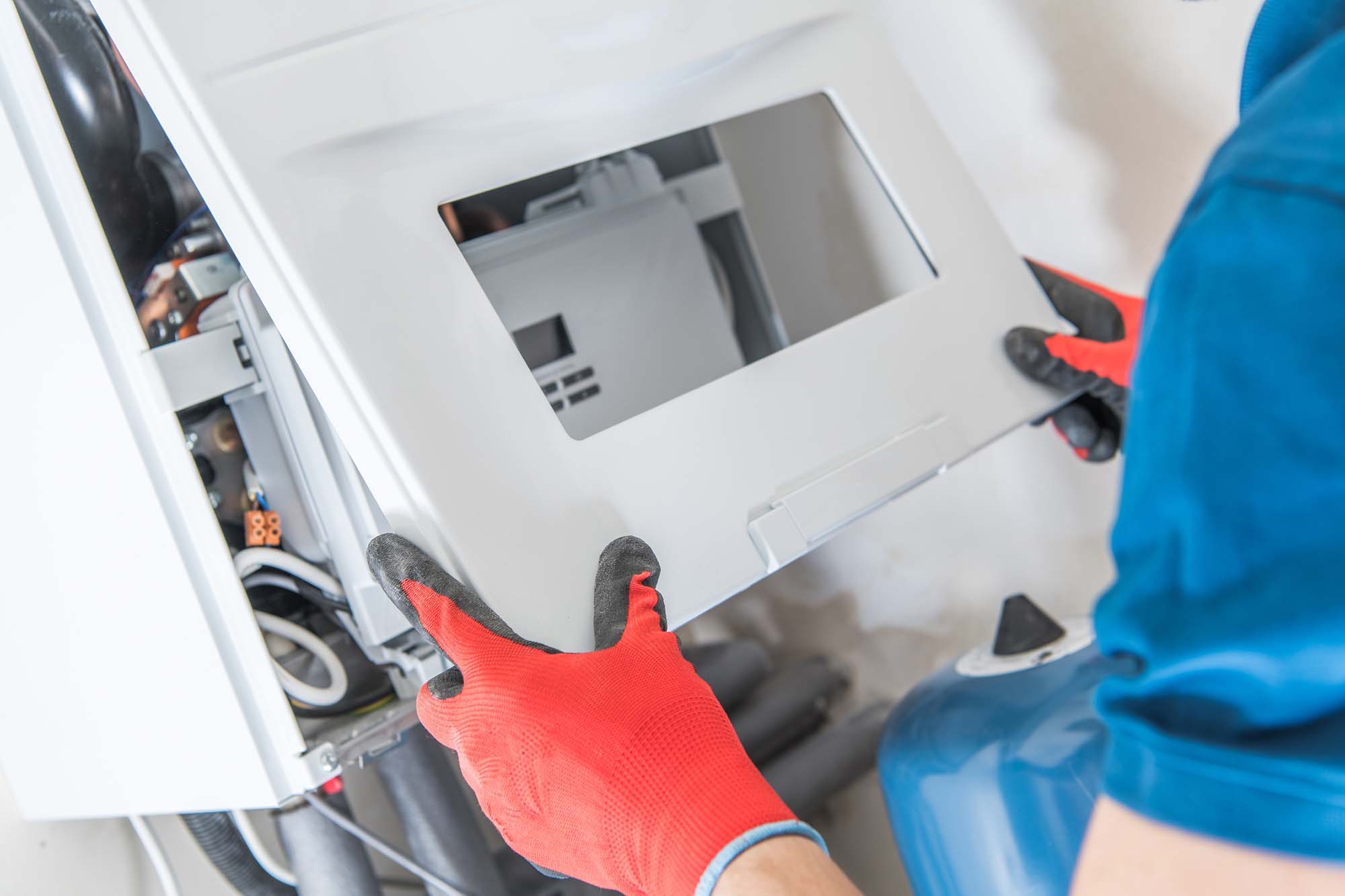
The right boiler type is decided by how many people want hot water at the same time, not by which one is newest or most talked about. A single-bathroom flat and a five-bedroom house with three showers have very different needs, even though either could technically run a combi.
Here is how the three main boiler types compare on the things that matter day to day, plus where they sit if you are thinking about a heat pump in future.
The three types in plain terms
- Combi: heats water on demand, no cylinder or loft tank, compact and simple
- System boiler: heats water into an unvented or vented cylinder, no loft tank needed, good for multiple bathrooms
- Conventional (regular) boiler: uses both a cylinder and a loft cold water tank, common in older properties
Simultaneous demand and mains flow rate
A combi heats water instantly as it is drawn, which means its output has to be shared if two taps or showers run at once, causing a noticeable temperature or pressure drop.
Mains flow rate, measured in litres per minute, also limits a combi directly, since it can only heat what is coming through the incoming main. A property on a weak mains supply, common in some rural parts of the Borders, will struggle to run a high-output combi shower well regardless of the boiler's kW rating.
A system or conventional boiler with a decent-sized cylinder stores hot water in advance, so two showers running together simply draw down the stored volume rather than competing for instantaneous output.
Cylinder and loft space
Combis need no cylinder or tank, which is why they suit flats and smaller houses where airing cupboard space is tight.
System boilers need cylinder space but no loft tank, useful where loft access is poor or a loft conversion has removed the tank space.
Conventional boilers need both a cylinder and a loft tank, and are increasingly only kept where the existing pipework makes conversion impractical or where an open-vented system is preferred for a private water supply.
Decision table
| Household situation | Best fit | Why |
|---|---|---|
| One bathroom, flat or small house | Combi | Simple, no storage needed, low running cost |
| Two or more bathrooms, decent mains pressure | System with unvented cylinder | Strong simultaneous flow, no loft tank |
| Weak or variable mains pressure | System or conventional with pumped cylinder | Stored water is not affected by mains fluctuation |
| Existing loft tank, limited budget for conversion | Conventional (retained) | Avoids the cost of full conversion |
| Considering an air source heat pump later | System with cylinder | Heat pumps work best with stored hot water, not instant combi heating |
Heat pump readiness
If a future switch to an air source heat pump is on your mind, a system boiler with a cylinder is the easier stepping stone, since heat pumps are designed to heat water into storage rather than instantly on demand. Combis do not have a direct heat pump equivalent in the same way.
This does not mean you need to convert now, just that keeping cylinder space, even if unused, keeps the option open without extra building work later.
Two real households compared
A retired couple in a two-bedroom Kelso cottage, with one bathroom and a shower over the bath, rarely need more than one hot outlet running at a time. A combi suits this household well, since there is no cylinder standing loss to pay for and no cupboard given over to a tank.
A family of five in an East Lothian farmhouse, with two bathrooms and a utility sink all wanting hot water at breakfast time, will find a combi struggling to keep up no matter how high its kW rating. A system boiler feeding a well-sized unvented cylinder gives each outlet a strong, steady flow because it draws from stored water rather than trying to heat it all instantly.
The difference is not the size of the house, it is the number of hot water demands that genuinely overlap during the day.
Testing your actual mains flow rate
Before assuming a combi will cope, it is worth having the incoming mains flow rate measured rather than relying on the water company's general area figures. This is done with a flow rate test at the kitchen cold tap, running water into a measuring jug for a set time and calculating litres per minute.
A flow rate below around 10 litres per minute at good pressure will limit even a well-specified combi's ability to run a strong shower, and may point towards a system boiler and cylinder, or in some cases a pumped combi installation, as the more reliable option.
Upgrade paths between types
Moving from a conventional boiler to a system boiler is usually the most straightforward conversion, since the loft tank is removed but the existing cylinder position can often be reused or upgraded to an unvented model.
Moving from a combi to a system boiler later, for example after a loft conversion adds a third bathroom, means finding new cylinder space and running additional pipework, which is a bigger job than the reverse and worth planning for at the design stage of any renovation.
Frequently asked questions
- Can a combi run two showers at once?
- It can, but both will share the boiler's output and mains flow rate, which usually means a drop in pressure or temperature at each outlet.
- Is a system boiler always better than a combi?
- No, for a single-bathroom household a combi is usually simpler, cheaper to run and needs no cylinder space. System boilers earn their keep with higher simultaneous demand.
- Do conventional boilers need replacing outright?
- Not necessarily. Many conventional systems are converted to system or combi setups at end of life, but a well-maintained conventional boiler can still be serviced and repaired.
- Which type is cheapest to install?
- A like-for-like combi swap is usually the cheapest, since it avoids cylinder or tank work. Conversions between types cost more due to the extra pipework and removal work.
Not sure which boiler type suits your home?
We'll look at your bathrooms, mains pressure and cylinder space before recommending anything.