
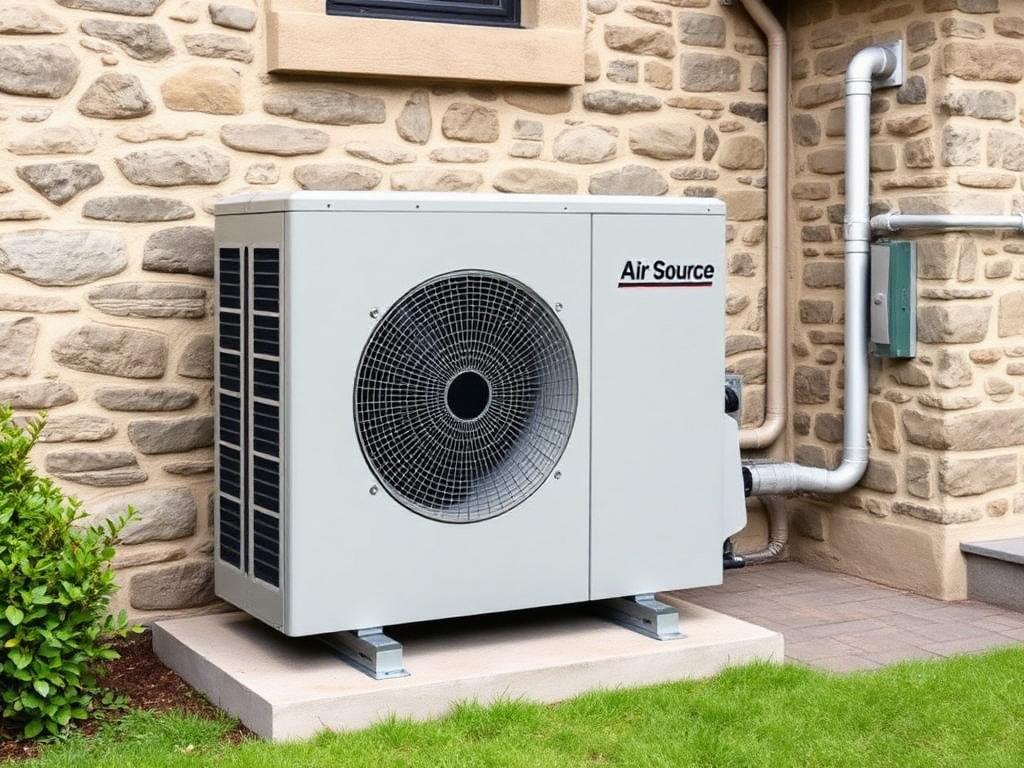
Two questions come up in almost every heat pump conversation before anyone mentions efficiency: where does the box go, and will we hear it. Both are legitimate, and both have better answers than people expect — provided the siting is thought about at survey rather than on the day of installation.
This guide covers siting, real-world noise, and how Scottish planning treats air source heat pumps, including the conservation areas and listed properties that are common across the Borders and East Lothian.
What a heat pump needs from its position
- Free airflow in and out. The unit takes in a large volume of air and blows it out colder, so it must not be boxed in or recirculating its own discharge.
- Clearance at the front, back and sides, to the manufacturer's stated distances — typically a few hundred millimetres at the rear and a metre or more of free space at the discharge.
- A stable, level base: a purpose-poured slab or proprietary ground stand, or wall brackets on suitable masonry.
- A route for condensate to drain away safely and not freeze into a sheet of ice on a path.
- A reasonably short pipe run to the cylinder to limit heat losses, though modern insulated runs handle longer distances than people assume.
- Somewhere it will not be buried in a snowdrift or blasted by the prevailing wind off the Lammermuirs.
How loud is it really?
A modern air source heat pump running at part load is quiet — comparable to a fridge in the next room rather than an air conditioning plant. Perceived loudness depends far more on siting than on the unit: a heat pump a couple of metres from a bedroom window under a hard rendered wall will be more noticeable than the same unit at the gable end across a lawn.
The unit runs hardest on the coldest nights, which is exactly when windows are closed. Most owners report that they stop noticing it within a fortnight. Defrost cycles, where the unit briefly reverses to clear frost from the coil, are the one thing people ask about — they last a few minutes and sound different rather than louder.
| Source | Roughly comparable to | Notes |
|---|---|---|
| Heat pump at 1 m, full load | Normal conversation | Only in the coldest weather |
| Heat pump at 3 m, part load | Quiet office | Typical winter operation |
| Heat pump at 5 m, part load | Rural background at night | Usual perceived level from a garden |
| Defrost cycle | Brief change in tone | A few minutes, several times in cold damp weather |
| Fridge in a kitchen | Baseline for comparison | Most owners' reference point |
Scottish permitted development in outline
In Scotland, air source heat pumps on domestic properties often fall under permitted development, subject to conditions relating to siting, size, proximity to boundaries and whether the property is in a designated area. Conditions differ from those in England, so advice written for an English audience should not be relied on here.
The practical position: for a typical detached or semi-detached house outside a conservation area, permitted development usually applies if the unit is sensibly sited. For flats, listed buildings, conservation areas and properties within designated landscapes, you should assume an application may be needed and check with the local planning authority — Scottish Borders Council or East Lothian Council — before ordering equipment.
Listed buildings and conservation areas
- Listed building consent is a separate matter from planning permission and can be required even where planning is not.
- Siting out of public view — a rear courtyard, behind a garden wall, at a gable away from the street — makes consent far more likely.
- Screening with timber louvres or planting can help, provided airflow clearances are genuinely maintained. A solid enclosure will strangle the unit.
- Fixing to a historic elevation is often the objection; a ground-mounted unit set away from the building usually reads better to a conservation officer.
- Engage the planning department early. A five-minute conversation before design is worth far more than an appeal afterwards.
Keeping neighbours comfortable
Most neighbour objections are about the unknown rather than the noise. Telling a neighbour what is happening, where the unit will sit and roughly how loud it is prevents almost all of them. Where a boundary is tight, siting the discharge away from the neighbour's windows and adding a modest acoustic screen at a proper clearance distance resolves the rest.
Where a property is terraced or the plot is very tight, it is worth being realistic at survey. Occasionally the honest answer is that the available position will compromise either performance or amenity, and a hybrid system or a different approach serves the household better.
Winter siting details that matter here
- Raise the unit clear of expected snow depth on exposed sites — a ground stand rather than a low slab.
- Route condensate to a soakaway or drain with a heated or self-draining arrangement, never across a footpath where it can freeze.
- Keep the unit out of the direct line of driven snow where possible, or accept more frequent defrost cycles.
- Avoid positions under a gutter that discharges over the unit or under a roof that sheds snow onto it.
- Leave access for servicing — the unit needs to be reachable with the coil clear of vegetation.
How we handle it
Siting is part of the survey, not an afterthought. We look at airflow, noise paths to your rooms and your neighbours', condensate routing, snow and wind exposure, and the planning position for the specific property before the design is finalised.
Where consent is likely to be needed, we will tell you at survey so you can factor the timescale in rather than discovering it at installation.
Frequently asked questions
- Do I need planning permission for an air source heat pump in Scotland?
- Often not, because many domestic installations fall under permitted development subject to conditions. Flats, listed buildings and conservation areas are more likely to need consent. Always confirm with your local planning authority before ordering.
- Will my neighbours hear it?
- Usually barely, if it is sited sensibly. Discharge direction, distance from windows and avoiding hard reflective surfaces close by matter more than the unit's rated sound figure.
- Can the unit go in a garage or an enclosure?
- Not in a sealed space. A heat pump needs a large volume of moving air. Louvred screening at proper clearance distances is fine; an enclosed garage or a tight boxed-in recess is not.
- What happens during a defrost cycle?
- The unit briefly reverses to melt frost off the outdoor coil, then resumes. It lasts a few minutes, may produce a plume of vapour and a change in sound, and is entirely normal in cold damp weather.
Get the siting right before anything is ordered
We assess airflow, noise paths, condensate routing and the planning position for your property as part of the heat pump survey.